Wednesday, March 06, 2013

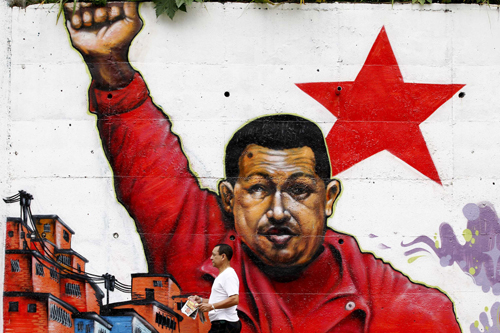
Venceremos


I am happy for everything he accomplished in life. What I will most miss about him are his colorful speeches. He was a brilliant speaker who could deliver a two hour speech without even glancing at notes. As an American I was fascinated to see a Latin American leader speak about the empire and the history of Latin America. He spoke in an illuminating manner about issues which American media outlets rarely discussed.

Contrary to how he may be depicted in the vast majority of the American media outlets, Hugo Chavez was not anti-American. One of the most quotable things he ever said was, "The U.S. is a great country, and it will always be a great country, but there will come a day when it will no longer be an empire, and the driving force of a hegemonic project. "

To refer to Latin American leaders such as Hugo Chavez, Evo Morales, and Rafael Correa who assert their countries' soveriegnty as anti-American is like referring to black people who assert their civil rights as anti-white.

Among his accomplishments was to assert Venezuelan control over Venezuelan oil resources, an important achievement for any country, to control its own resources. He also diversified the client base for Venezuelan oil. Apart from this, unlike his American detractors who are obsessed with perpetuating their radical oil dependence, he was aware that an oil rich country cannot transform itself without diversifying its economy. He invested in education and provided free healthcare to all of Venezuela's citizens. He also made a commitment to achieving nutritional self-sufficiency within his country.

Yet, perhaps his greatest accomplishment is not any of the foregoing, but the fact that like other men who came before him such as Jesus, Buddha, Ghandi, King, X, Cesar Chavez, etc., he changed the consciousness of the world he lived in. He demonstrated that it is possible to create revolution and challenge the Anglo-Saxon hegemonists of the North American continent.

Labels: , , , , , ,

Wednesday, February 20, 2013

Do The Harlem Shake...Con Los Terroristas!


This is a compilation video which traces the evolution of the meme and features some of the best Harlem Shake videos. This meme has become an immense viral phenomenon, with some people loving it, some people hating it, and many others left bewildered.

Perhaps several lines from the Herman Hesse novel, Steppenwolf, can help explain the appeal of what appears to be a collective catharsis or a trance in which the music takes over the mind and the body and everybody joins together in uninhibited expression and lets go. Hesse wrote about "the intoxication of a general festivity, the mysterious merging of the personality in the mass, the mystic union of joy," as well as, "I myself breathed the sweet intoxication of a common dream and of music and rhythm."

For me, the most astonishing aspect of the viral phenomenon is the phrase which is blurted out in a high pitched voice at the very outset of the song and repeated within the first thirty seconds, "Con los terroristas!" As well as the fact that while there has been much discussion about the Harlem Shake phenomenon, very little of it has been about this phrase or its meaning. Among the most prominent search results regarding this meme, Know Your Meme, The Huffington Post, and CBS news don't even mention it. The Fader has a very brief discussion regarding it, but does not discuss its meaning. Baauer is apparently not discussing it either.

Is the monolingualism of Americans so bad that dozens of millions of people have viewed these videos, and thousands have particpated in the making of them, including universities, large companies such as Pepsi, media organizations such as Facebook, Anderson Live, The Jimmy Fallon Show, as well as the army, navy, and marines, without realizing the meaning of the expression, "Con los terroristas?"

Is it not highly ironic that American military personnel who are engaged in a "war on terrorism" are frolicking about with wild abandon to a song which prominently features the expression, "Con los terroristas?" Does it not contradict their stated objective of combatting terrorism and undermine the image of the armed forces which top military commanders, including the President himself, would like to project?

Is it not ironic that media outlets who sold Americans on the logic of the Afghanistan and Iraq wars as a means to combat and prevent terrorism completely overlook this phrase in their discussions of the meme?

Out of the hundreds of thousands of words in the Spanish language, and millions of words in other languages, Baauer chose to use a sample which when translated to English means, "With the terrorists!" To further consider how subversive the use of this sample is, imagine a club full of people who when this song comes on, cheer and chant the phrase, "Con los terroristas!" then proceed to dance their brains and asses off. Or a free outdoor festival which features djs in which this song gets played, and a chorus of thousands of people bellows out, "Con los terroristas!" after which the crowd goes crazy.

While Americans may be limited by their monolingualism, the rest of the world is less so. Millions of Americans may not know what the meaning of the phrase is, but people throughout the rest of the world may find themselves reveling in a symbolic yet conscious act of subversion and defiance against the policies of the United States, and its President, who for many is barely distinguishable from the terrorists which he claims to be combatting and freeing the world of, due to his authorization of drone strikes which kill innocent civilians including women, children, and first responders who were merely assisting victims of the initial strike.

Some people may suggest that the words are meaningless. Yet a google search for "Which artist did Baauer sample on the Harlem Shake," demonstrates that people in fact attribute a lot of importance to words. The search turns up numerous discussions and links regarding the line, "Do the Harlem Shake, " attributed to Jayson Musson, which is delivered in a low, nearly imperceptible tone, whereas the line, "Con los terroristas" is high pitched and nearly impossible to miss. Some of these discussions go so far as to suggest that the Baauer song is about graffitti or that Jayson Musson himself, is the reason why people are dancing to The Harlem Shake.

I believe in, and have observed on occassion, the subconscious expression of sexual desire, and similarly believe in the subconscious expression of rebellion. I find it an intriguing possibility that the Harlem Shake viral phenomenon is a manifestation of a massive subconscious rebellion against the so called war on terrorism as articulated, constructed, and executed by the American government, which has led to wars in Afghanistan and Iraq that have cost hundreds of thousands of lives, trilliions of dollars, and have led the American government to legally justify physical torture and the extrajudicial execution of American citizens.

In an article titled, The Massacre of the Afghan 17 and the Obama Cover-Up, whose topic was selected as the 23rd most censored story by Project Censored for 2012, author James Petras discusses the implausibility of the official U.S. government story that a single deranged gunmen, Robert Bales, acted alone in the massacre of 17 Afghan villagers in Kandahar province on March 11, 2012, and the possibility that Barack Obama has conspired with the US military command to cover up the facts and hide the true nature of the war in Afghanistan.

Regarding the American troops, Petras writes, "They are engaged in a long, losing war where every dead US soldier is accompanied by scores who are maimed, blinded and mentally traumatized. In Obama's war, the wounded are patched up and recycled back into the same meat grinder in an increasingly hostile environment."

As to Obama's motivations for participating in the cover-up, Petras writes, "Obama has to conspire with the Pentagon in covering up this mass murder, defending the officers in charge of these 'pacified' villages, because there are no alternatives, no back-ups, no new recruits eager to engage in the 12th year of war in Afghanistan.There are only the re-cycled killers, willing to pursue their career in 'Special Forces' involving 'kill and destroy' operations...President Obama cannot allow an entire garrison, including their commanding officer to be put on trial for the war crimes in this massacre. Holding anyone, besides the hapless Sgt. Bales accountable for the massacre would incite a general rebellion within the armed forces."

Petras ends the article by writing, "Clearly prolonged colonial wars cannot be sustained through the consent of the citizens and such wars cannot be prosecuted according to military manuals and the Geneva Conventions. At this point, only Presidential 'rule by decree' can secure compliance of the citizens at home and only massacres and cover-ups can sustain the colonial occupations abroad. But these are desperate and temporary: When the extreme measures have run their course there will be nothing to fall back on and nothing can save the president of a collapsing empire from the revolt of its citizens and soldiers."

Since September 11th, 2001, I have been of the conviction that war as a response to terrorism is illogical and unjustifiable. It is a point of view that is rarely expressed in traditional media outlets. I believe it is a conclusion which Americans must collectively arrive at if we are to ascend above the military, economic, and moral quagmire we find ourselves in.

Labels: , , , , , , , , , , , , , ,

Thursday, June 07, 2012

Salvemos A Mexico


Politicians have the ability to speak positively and confidently about anything, even if the situation is dire. Recently, I watched the Mexican presidential debate on estamosdelachingada.com, which roughly translates to wearefucked.com, and the candidate for the party(PAN) which has turned Mexico into the decapitation capital of the world spoke about creating, security, peace, and economic prosperity. Do such people deserve reelection? 


According to UNESCO statistics, 28% of Mexicans of high school age, actually attend high school. Do the people(PAN and PRI) who have allowed this situation to persist for generations deserve reelection? Is it not farcical for a country to pretend to make strides towards becoming a developed country if 72% of its high school age population does not attend high school? Mexico also has the lowest economic growth in Latin America. 


The leftist candidate, Andres Manuel Lopez Obrador, aka AMLO, who can make a credible claim to actually having won the election of 2006, told a story-drawing a parallel to how the PRI candidate, Enrique Peña Nieto, is backed by television giant Televisa-about how after Mexico lost half of its territory to the U.S., Santa Ana fled to Colombia, yet the Mexican elites brought him back and installed him as President. They told him, "Don't worry. We own all the newspapers in Mexico City. We control public opinion."

Numerous countries in Latin America have elected leftist presidents who have given real hope to their populations, created real change, and asserted their country's sovereignty. It will be sad to see Mexico stay behind this wave of change for another six years with a government subservient to the U.S. , if either the PAN or PRI candidate wins.

Unfortunately, AMLO is a horrible debater in my estimation; half the time he barely answers the question and returns to his overall message about how Mexico is ruled by elites, and that Mexico must opt for real change. Perhaps the core of his success lies with his campaigning and not debating. He is surging in the polls. 

Hopefully, the wave of change that has swept Latin America will reach Mexico in 2012, the year of the Mayan prophecy. Otherwise, to echo the sentiments of the webpage creator, "Estamos de la chingada!" 


The next debate is June 10th, 2012.

Labels: , , , , , , , , , , ,

Thursday, April 26, 2012

The World According to Thor Halvorson


I was watching CÑÑ recently and the guest for the entire hour was a Norwegian-Venezuelan named Thor Halverson. You may have heard of his son, although I hadn't until I googled this man's name to make sure of his name's spelling and confirm his identity.

They say that the apple doesn't fall far from the tree, which in this case is both unfortunate, and cause for mild amusement. I rarely watch television and in fact had been experiencing a media blackout for months, but was quite entertained and amused.

According to this man who is the former drug czar of Venezuela in an adminstration prior to Chavez's, some institute in England concluded that the files found in Raul Reye's computer 3 years ago, confirm the connection between the FARC and Hugo Chavez and the FARC and Ecuadorean President Rafael Correa. He expressed absolute faith in the findings, but acknowledged that it is an issue that both the Columbian and Venezuelan governments have turned the page on.

He further went on to say that the Venezuelan government is involved in drug trafficking, the campaign of Rafael Correa accepted financial contributions from the FARC, the government of Manuel Zelaya was involved in drug trafficking as well, but the current government of Honduras no longer is, however, the Nicaraguan government is involved in drug trafficking , and during the 1980's, Fidel Castro set up the drug lanes for Pablo Escobar Gaviria. This last piece of information is absolutely astonishing. Not only did the government headed by Fidel Castro provide healthcare for all of its citizens during this time, at the very same time Fidel Castro himself set up the drug lanes for PEEG. Wow! That's what I call efficiency. What is the President of Mexico doing wrong?

Furthermore, Hezbollah, Hamas, Palestinian jihadists, Al-Qaeda, and the Taliban are involved in drug trafficking in Latin America as well. Also, all of this drug trafficking is destabilizing governments in West Africa. For his part, Thor expressed that he has always maintained excellent relationships with the CIA and the DEA. Meanwhile, the near non-existant coverage of Latin America by the Los Angeles Times continues. What is a well intentioned resident of Southern California and citizen of the world to believe?

On any given day, there is 2 to 3 times more coverage about Europe or the Middle East than Latin America, and it's been that way for years. How can this lack of coverage be justified, particularly when one considers that half of the population of Los Angeles County is of Latin American origin? Perhaps the Times can justify it by saying that those residents of Latin American origin don't read the L.A. Times, or by citing lack of resources, or by suggesting that what happens in Latin America is less important than what happens in Europe or the Middle East.

I do not criticize its lack of coverage, I merely point it out. However, according to Mr. Halvorson, intriguing, nefarious, criminal events involving governments and terrorists are occurring in Latin America, all with the ultimate aim of delivering lines of white powder to the noses of American consumers, and his claims are the subject of serious discussion on a prestigious cable network.

What can be expected of the average American to know about Latin America considering that major media outlets hardly cover it, and others provide a mainly distorted and biased perspective? Even PBS, in the documentary, The Hugo Chavez Show, referred to Evo Morales, Rafael Correa, and Hugo Chavez, as "anti-American."

Since the turn of the century, numerous Latin American leaders have been elected who have asserted their country's sovereignty and challenged Anglo-saxon hegemony. At one point Cuba was largely ostracized from the rest of Latin America and excluded from the Organization of American States, which it subsequently refused to join. Now the Latin American countries have formed a new regional organization, CELAC, which Cuba is a part of, and excludes Canada and the United States. If Americans were aware of this process, of the unraveling of Anglo-saxon hegemony, perhaps they could relate it to the overall downfall of their empire, and have anticipated the direst recession since the great depression of the 1930s, and have been further along in the process of creating transformative solutions to our ecologically and economically unsustainable society. The reality is that the rest of the world does not depend on the resources of the U.S. to sustain itself, the U.S. depends on the resources of the rest of the world, particularly oil, to sustain itself.

In the year of 2012, when there is so much interest in Mayan culture and civilization, Anglo-saxon hegemony stands to be dealt another blow in Mexico's elections, and the words of an Aymara, Evo Morales when he visited Mexico, may come closer to being realized, that "Mexico too shall be free."

I suppose CÑÑ and other traditional media outlets will keep informing us how full of anti-American, drug dealing, socialists Latin America is.

Labels: , , , , , , , , , ,

Saturday, March 19, 2011

Obama Come Home!


TelesurTV is reporting that Barack Obama's visit has been the cause of protests in Brasil and is expected to be met with protests in Chile, as well. Friday's protest ended in front of the American consulate and was dispersed by military police using tear gas and rubber bullets according to Brazilian news outlets.

According to the press release cited by Telesur, the protest is against the "imperialism of the United States and the demagoguery of Obama, who practices a militarist and interventionist policy, while he uses a rhetoric of defense of human rights."

Telesur is also reporting that the American consulate has announced that Obama's speech will no longer take place in a central square in the open air, but in an indoor location.

Folha.com has published numerous photographs related to the event and will surely publish many more in the next few days which promise to be very colorful, as well as videos, although their videos don't seem to load.

Poor Imperial Chief.

Labels: , , , , , , , ,

Thursday, November 04, 2010

The California Difference


After the resounding victory of Democrats for statewide offices in California, Senator Boxer's victory, as well as the imposition of a will contrary to that of Republicans on important propositions such as 23 and 25, commentators and analysts are asking about and analyzing the differences between California and the rest of the country.

To begin to explain the difference, let me begin by stating that California has finally elected an intelligent and well qualified Governor. Let us remember that when Arnold Schwarzenegger was first elected Governor, he was a right wing activist, would often say idiotic things, and had no political experience. I give him credit for learning on the job and transforming himself. He broke ranks with conservative Republicans, so much so, that during budget negotiations reporters would say that he acted more like a Democrat, than a Republican. The vast majority of bills that he signed into law, were written by Democrats, including the most historic and significant piece of legislation, for which he will be remembered, AB 32, which was written by Fran Pavley and Fabian Nuñez. California changed Arnold.

Then along comes Meg Whitman sounding exactly like the old Arnold used to, as the brilliant political ad below demonstrates. Since she had the same campaign director as Arnold did in 2003, Pete Wilson, it's not surprising. They were probably coached by the same people as well.

After 7 years of Arnold Schwarzenegger as Governor, 8 years of George Bush as President, and 2 years of Barack Obama as President, to whom can Californians attribute responsibility for the general economic downturn in California and the 12.4% unemployment rate? It should be obvious that a far more profound process is taking place, and the proposition that Meg Whitman was somehow uniquely qualified to turn things around for California and reduce the unemployment rate because of her experience as CEO of Ebay is ludicrous. For people who believed that, I have bridge I would like to sell them.

Jerry Brown on the other hand, is intelligent, visionary, and experienced. He is the best qualified candidate to be elected Governor in my lifetime.

The difference is that California is the most populous state in the nation, and has very large urban concentrations, such as Los Angeles county, and the San Francisco Bay Area. Our urban experience gives us a different insight. The premise upon which the Meg Whitman campaign was based on is an insult to my intelligence and, I'm sure, to the intelligence of millions of Los Angeles county and San Francisco Bay Area residents. Remove Los Angeles county and the San Francisco Bay Area from the equation, and California is surprisingly conservative.

To further explain the difference, one thing that I can state with certainty, and I believe the vast majority of Californians would agree with me, is that the American economy will never improve unless it reduces its radical oil dependence. Yet, I have never heard or read a single proposal formulated by a Republican that would do that. In fact, they take the opposite perspective, as exemplified by the motto many of them have adopted, "Drill, Baby, Drill," their willingness to act against the scientific consensus on important issues such as climate change, and the irrational and impractical position which is nearly universal among them, of being against any and all tax increases. In California, dozens of Republican state legislators even went as far as signing a pledge stating such opposition.

Such an irrational and impractical position would impede Republicans from ever funding the mass transit our society direly needs, yet the vast majority of the industrialized world has per capita oil consumption rates which are 40 to 60% below that of the United States, primarily due to mass transit.

There is a common perception that Republicans have trouble attracting Latino votes, particularly in California, with which I agree. However, there are those who point out that Republicans don't have trouble attracting Latino votes in Florida or Texas. We must acknowledge the very real differences that exist between the two largest latino groups in Florida and California, i.e. Cubans and Mexicans, but also that the population of Los Angeles county and the San Francisco Bay Area is larger than the entire population of Florida and is about 70 to 75% of the population of the entire state of Texas, depending on which statistics are used.

San Francisco, Los Angeles, we are a revolution! Onwards towards making mass transit the primary mode of transportation in the state and decriminalizing marijuana.

Labels: , , , , , , , , , , , ,

Tuesday, October 26, 2010

Some of the Global Repercussions of Proposition 19


The AP is reporting that certain Latin American leaders are questioning the wisdom of California's ballot measure to legalize marijuana. The five leaders mentioned are Juan Manuel Santos of Colombia, Felipe Calderon of Mexico, Porfirio Lobo of Honduras, Alvaro Colom of Guatemala, and Laura Chinchilla of Costa Rica.

Juan Manuel Santos of Colombia, obviously does not believe in Colombian soveriegnty. He is quoted as saying, "How can I tell a farmer in my country that if he grows marijuana, I'll put him in jail, when in the richest state of the United States it's legal to produce, traffic and consume the same product?"

Whether or not it should be legal for a Colombian farmer to grow marijuana is a matter of Colombian soveriegnty, and should be decided independently of what U.S. policy is. In an ideal world, of course.

It is astonishing, the crass subservience to the U.S. government that these leaders espouse.

Felipe Calderon of Mexico, whose nickname in Mexico is FECAL, is not even the legitimate President of Mexico. He won by 6 tenths of 1 percent in an election in which there were credible allegations of fraud. Prior to his election, the Mexican Congress had passed a law that would have decriminalized a host of drugs, including marijuana. The former President vetoed it. Upon his election, the current President decided to make a "war on drugs" his top priority.

If democracy would have been respected in Mexico, the "war on drugs" would not be a top priority, the country would be under different policies with different results. Instead, 28,000 Mexicans have died over the last 4 years out of the sheer subservience of the Mexican government to the American government.

Porfirio Lobo of Honduras is not the legitimate President of Honduras either. He would not be President of Honduras if it were not for a coup. Some governments of the region have not yet recognized the legitimacy of his government, unfortunately, the U.S. has, and is even suspected of orchestrating the coup.

I do not know too much about Alvaro Colom of Guatemala or Laura Chinchilla of Costa Rica, but judging by the company they keep, I would assume that they have similar perspectives. The group as a whole I would classify as the puppets of the Empire.

I have not yet read the California Legislative Analyst's assessment of Proposition 19. I have read an article which is critical of it by former California gubernatorial candidate and marijuana decriminalization advocate Dennis Peron. However, I certainly do agree with the concept decriminalizing marijuana. May California take a bold stance, either now, or in the near future.

Labels: , , , , , , , ,

Monday, June 21, 2010

A Revolutionary Team


Thursday's 4-1 victory by Argentina over South Korea showcased Lionel Messi rising to the occassion and leading his team to a commanding victory. He fought for balls, dribbled past defenders, and made passes that turned into goals. As of yet, I have not seen another player in this World Cup make as big an impact on the game as Messi. I believe that Messi can be the key to a World Cup Championship for Argentina, in spite of the generally low expectations and lack of confidence in the team, a situation which I'm sure has changed considerably since the start of the tournament.

The team's coach, Diego Maradona, is the perfect person to recognize Messi's potential in the world cup and nurture it so that it can be realized. He led Argentina to a World Cup championship in 1986 and scored the "Goal of the Century" along the way. He also led his team to another final in 1990 and almost single handedly eliminated Brazil in the process. He would have led his team to another final in 1994 had he not been expelled,

It is very gratifying for fans and friends of Maradona to see him experience success as a coach in his first World Cup. His popularity, along with Messi's, creates fans of the Argentinean team all over the world, and is not just based on his feats in the field, but also on his outspokenness, his support for revolutionary change, and his open stances on issues of social justice.

For example, at the May 24, 2010 game against Canada, the team displayed this banner in support of the Abuelas de la Plaza de Mayo(Grandmothers of the Plaza de Mayo), which looks for children taken away from their murdered parents by the last military dictatorship in Argentina. Supposedly there is a large flag at the Argentinean team's living quarters in South Africa with the same message. The leader of the group, Estela de Carlotto, has expressed her appreciation for Maradona's "explicit support."

During George Bush's trip through South America which Hugo Chavez mirrored, mocking Bush and challenging American policy, Maradona was at the front of the march, the day Hugo Chavez spoke in Argentina.

Maradona has been attributed with saying that if the Catholic Church is so concerned with the plight of the poor, why doesn't it take its wealth and give it to them?

Diego Maradona is personal friends with Fidel Castro and Hugo Chavez. In one of the following videos, you can see Maradona in an interview with Hugo Chavez in which he declares his support for him and that he "hates everything that comes from the United States."

In one of the other videos you can see him in an interview with Fidel Castro in which he discusses that he's been stopped at the airport in Miami, strip searched, and denied entry into the United States. He states, "Some of us can live without the United States."

Bolivian President Evo Morales, also a friend of his, is rooting for Argentina too.

The success of the Argentinean team and Maradona as a coach will highlight and reflect some of the revolutionary changes that have occurred in the hemisphere. The world has changed, and the empire is still limping behind. I suppose the World Cup along with Oliver Stone's next movie will considerably open American's eyes to the realities of the continent.


Labels: , , , , , , ,

Wednesday, May 20, 2009

The Aftermath

California was in no mood to approve short term solutions yesterday as the map demonstrates. Mainstream politicians have not brought before the voters fundamental changes to our socioeconomic structure such as the ones I discussed in yesterday's entry, because they are perceived as politically inviable. Voters have demonstrated that the short term solutions they were asked to approve are not politically viable either. It will be interesting to see how politically viable the cuts in programs and social services which are now being threatened will be, and what effect they will have on the society in the context of a plummeting economy. The opportunity for real changes is the best when the society has collapsed, or is perceived as being on the verge of collapsing. May Californians see the light and transform their socioeconomic structure which is neither ecologically, nor economically sustainable, and which I would characterize as sadomasochistic.

Labels: , , , , , , ,

Tuesday, May 19, 2009

The Useless Election

Today, California is voting on six initiatives that have all been placed on the ballot by the state legislature. Among them, proposition 1A extends recently passed tax increases for two additional years. Three of them combined will raise $6 billion dollars through borrowing and redirecting money, thus reducing the projected budget deficit to $16 billion from $21 billion. A mass of mainstream politicians including Gov. Arnold Schwarzenegger and Los Angeles Mayor Antonio Villaraigosa support the measures which were the result of the most overdue budget in state history. The Los Angeles Times endorsed all of them except 1B. Five out of six are expected to lose and the measure with the most minimal impact, limiting pay increases for legislators if there is a budget crisis, is expected to pass.

I have not been paying much attention until very recently, don't plan to vote, and have taken the time to learn about the propositions out of curiosity. The measures are largely short term solutions that avoid fundamental changes the state needs to make, such as reforming proposition 13, which Arnold Schwarzenegger has explicitly opposed in the past. Borrowing $5 billion from future lottery earnings essentially relies upon the same logic as borrowing $15 billion to fix the budget problem in 2004. Except now the problem which Arnold Schwarzenegger pledged to fix when first elected is worse than ever. According to the election material provided by the Secretary of State of California, "Even with the adoption of the 2009-10 budget package and assuming that all of the propositions on this ballot pass, it is expected that the state would face multibillion-dollar budget shortfalls in the coming years."

Yet Arnold Schwarzenegger has never considered taking the advice of his economic advisor in 2003, Warren Buffet, to repeal or reform proposition 13. Neither have the voters been asked to approve a reform of this measure, even though a reform of this measure is ostensibly of mutual interest to the Governor and the average Californian. The proposition capped property taxes and created an unfair property tax system which contributes to the budget crisis, shortchanges the education system and local governments, and creates housing scarcity and higher housing costs.

We've also never been asked to vote for universal healthcare, even though bills have been introduced in the legislature in the past. We've never been asked to fund the mass transit system our state direly needs, and we've never been asked to vote for publicly financed elections. We've never been asked to make the fundamental changes which are necessary to create a fairer and more sustainable society.

California collects most of its revenue from the personal income and the sales taxes. During what is being referred to as the most severe recession since the 1930s, revenue from such sources will fall more precipitously than revenue from property taxes. The palpable sudden loss in wealth, power, and prestige that the U.S. is undergoing is the sound of the empire crumbling. California must transform itself and not allow itself to be buried under the rubble by perpetuating a system which is regarded as malfunctional .

The election is as useless as Arnold Schwarzenegger as Governor. He pledged to fix the budget problem, now its' worse than ever. He denied that California had a revenue problem, but instead had a spending problem. The current drastic conditions have changed his mind. He began as a right wing advocate, only to confront defeat, and subsequently move further and further to the center until now he's just about the same as the man he replaced, Grey Davis.

Arnold Schwarzenegger is historically important not just because he's a movie star married to a Kennedy, but also because he broke with the Anglo-saxon hegemonists. During newscasts covering budget negotiations anchors and reporters have commented, "Arnold is not acting like a Republican, he's acting more like a Democrat." Every significant piece of legislation which he has signed during his governorship is virtually guaranteed to have been written by a Democrat. The most historically important perhaps being AB 32, The Global Warming Solutions Act of 2006, which was not only written by Democrats, but by a Mexican! Fabian Nuñez and Fran Pavley coauthored the bill. What awaits us after Arnold is perhaps the first Mexican governor of California since Pio Pico.

Labels: , , , , , ,

Saturday, February 14, 2009

Hugo Chavez on Al Jazeera: The multi-lingual video


One of the most powerful aspects of the internet is that it allows a person to have a bird's eye perspective. No longer do we have to limit ourselves to a monolithic perspective from a national television network. Such a monolithic perspective can be compared to other points of view throughout the world. One of my favorite personalities is Hugo Chavez for this reason. I found this video interesting because he is speaking in Spanish, there is an Arabic voice-over translation, and English subtitles, creating an intersection for perspectives from diverse regions of the world's population.

Here, Hugo discusses the American empire, how it is a threat to the world, how it attempts to perpetuate the American lifestyle through the acquisition of oil resources, and how such an empire must be countered through the rise of a multi-polar world. Since this interview, the American empire has become further debilitated, and the multi-polar world has gained strength.

Labels: , , , , , , , , , , , ,

Sunday, February 01, 2009

Barack Obama and the Mass Transit Revolution

In our society, certain goals are acknowledged to be necessary for achieving ecological as well as economic sustainability, such as reducing greenhouse gas emissions and reducing petroleum consumption. Reducing petroleum consumption would reduce greenhouse gas emissions, and since 99% of the fuel that powers American vehicles is oil according to the Department of Energy, transforming the transportation system of the society is fundamental for achieving these goals, as well as other quality of life goals such as reducing traffic and reducing smog.

Los Angelenos are intimately familiar with the undesirable results of compelling the vast majority of the population to drive in order to achieve an adequate level of mobility. They have also taken action: 67.9% of Los Angeles county residents recently voted for a measure(R) that will increase their local sales tax by 0.5% and contribute 65% of the revenue to mass transit. On a statewide level, Californians approved $9.95 billion of bonds to begin the construction of a bullet train that will connect Los Angeles to San Francisco in 2 1/2 hours(Prop 1A). In contrast to this, Californians rejected $3.425 billion of bonds to subsidize the purchase of high fuel economy or alternative fuel vehicles(Prop10).

While politicians have railed against foreign oil dependence over the last few years, overall U.S. oil consumption barely diminished until very recently. According to the Energy Information Administration, in 2007 American oil consumption dropped by 0.0003% from the previous year. According to the BP Statistical Review of World Energy, whose statistics regarding the U.S. are virtually identical to the EIA's, yet also contains statistics for most countries and all of the continents, and thus composes a global portrait, the total share of the world's oil which Americans consumed in 2007 was 23.9%. The disproportionate consumption of this vital resource by the U.S. is a fact which is becoming increasingly well known, referenced by everyone from Barack Obama to Venezuelan President Hugo Chavez. Although American oil consumption has been steadily rising since 1984 with a slip here and there, in November the Energy Information Administration projected that U.S. oil demand would drop by 5.4% in 2008 due to the U.S. economic downturn, the largest drop since 1980.

Barack Obama has declared that energy is the most important issue that our future economy will face. While his energy plan proposes to reduce greenhouse gas emissions by 80 percent below 1990 levels by 2050 through a cap and trade system, it sets no explicit goal for how much the U.S. will reduce its consumption of one of the two biggest sources of greenhouse gas emissions, and what the Department of Energy refers to as "the lifeblood of America's economy," i.e, oil, in the short or long term.

A numerical figure for how much the U.S. will reduce its consumption of oil under his plan must be deduced from his pledge which he has declared on numerous occasions to eliminate Middle Eastern and Venezuelan oil imports within 10 years. The goal in itself is an appeal to the ignorance and prejudice of Americans, and an analysis of his energy plan reveals means towards achieving it, and the greater goal of greenhouse gas emission reductions, which are contradictory, while it largely ignores the most fundamental solution which could have the most profound impact on many parts of the country, including California.

To begin with, the declaration promotes the misconception that the U.S. is dependent on the Middle East for oil, which is not the case. The United States imports more oil from the single country of Canada than it does from the Middle East. It imports more oil from South America than it does from the Middle East, and more oil from Africa than it does from the Middle East. Middle Eastern oil imports, at 2,208 thousand barrels daily, account for 16.4% of total U.S. oil imports according to the EIA. Regarding the "rogue" state of Venezuela, as Barack Obama likes to refer to it, at 1,361 thousand barrels daily, Venezuelan imports represent 10.1% of our oil imports according to the EIA. Such figures would add up to a reduction of roughly 26.5% of our total imports.

However, it is important to place these figures in context. The United States is the third largest oil producer in the world, producing 8.0% of the world's total, second only to Saudi Arabia and the Russian Federation which each produce 12.6%. The U.S. produces more oil than Canada and Mexico combined. It produces more oil than the entire Central and South American region, and it produces more than 2.5 times more oil than the country of Venezuela. This means that eliminating 26.5% of our oil imports over 10 years, only translates into reducing our overall oil consumption by 17.3% over 10 years.

To give greater perspective to this figure let us compare it to what other industrialized countries which already had lower per capita oil consumption rates accomplished during the same period of time in which the U.S. reduced its total oil consumption by 0.0003%. The United Kingdom reduced its oil consumption by 5%, driving its per capita oil consumption rate down to 40.9% that of the U.S. Switzerland reduced its oil consumption by 9.9%, driving its per capita oil consumption rate down to 47.9% that of the U.S. Germany reduced its oil consumption by 9.0%, driving its per capita oil consumption rate down to 44% that of the U.S. What these figures demonstrate, as well as the recent downturn in U.S. oil consumption, is that to propose in a costumed manner that the U.S. reduce its oil consumption by 17.3% over 10 years is hardly an ambitious goal. It is emphatically incommensurate with the larger goal of reducing greenhouse gas emissions by 80% below 1990 levels by 2050.

While some of his plan's proposals can work towards achieving his goal such as increasing fuel economy standards by 4 percent per year, other proposals will be largely inane within the timeframe of 10 years; such as getting 1 million plug-in hybrid cars on the road by 2015, which means that there will still be in excess of 250 million conventional cars on the road, and creating a $7,000 tax credit for purchasing an advanced vehicle. Regarding increasing fuel economy standards by 4 percent per year, this proposal is largely redundant because corporate average fuel economy(CAFE) standards have been legislated to increase to 35 mile per gallon by 2020 for cars and light trucks.

The primary goals embedded in Barack Obama's energy plan are to reduce greenhouse gas emissions, reduce petroleum consumption, and provide economic relief to Americans. Eliminating Middle East and Venezuelan oil imports obliquely serves the goal of reducing petroleum consumption, but does not serve the other two goals as one might imagine. The top five oil exporters to the U.S. are Canada, Mexico, Saudi Arabia, Venezuela, and Nigeria. Eliminating Middle East and Venezuelan oil imports would leave as the U.S.'s primary sources of oil imports Canada, Mexico, and Nigeria. Nigeria is a country that has lived with constant political instability which would make the U.S. economy more vulnerable to a price surge; Mexico is a country with diminishing proved oil reserves, which now stand at 9.6 years of production; and Canada whose proved oil reserves stand at 22.9 years of production, presents a dilemma: oil extracted from Canada's tar sands creates 3 times the greenhouse gases which conventional oil extraction creates. The U.S.'s own proved reserves to production ratio stands at 11.7 years. Potential new sources of oil such as that extracted from shale may create as much as 4 times the greenhouse gases as conventional oil extraction creates. According to Barack Obama's energy plan, he wishes to expedite such a process.

Achieving all of the primary goals outlined in Barack Obama's energy plan is improbable because while he makes proposals to relieve economic pressure, these very same proposals stimulate consumption, such as, stimulating and expediting domestic production. Providing a $1,000 emergency energy rebate to American families from a windfall tax profits tax on oil companies will relieve economic pressure, but increase consumption. Swapping oil from the strategic petroleum reserve to drive down prices, would increase consumption.

The plan also calls for phasing in 60 billion gallons of advanced biofuels into the fuel supply by 2030. A proposal that will make little difference in reducing oil consumption within a 10 year time frame, but has moderate potential in the mid to long term. Total U.S. gasoline consumption in 2007 was 142 billion gallons according to the Energy Information Administration. Diesel fuel accounted for another 64 billion gallons. We cannot assume that the price of such advanced biofuels will be lower than what the current price of gasoline is now or was several months ago.

Only at the very end of his energy plan, does Barack Obama dedicate one paragraph under the title, "Build More Livable and Sustainable Communities," to the concept that if the vast majority of the population was not compelled to drive everywhere, we would not consume nearly a quarter of the world's oil.

"Over the long term, we know that the amount of fuel we will use is directly related to our land use decisions and development patterns. For the last 100 years, our communities have been organized around the principle of cheap gasoline...They(Barack Obama and Joe Biden) believe that we must devote significantly more attention to investments that will make it easier for us to walk, bicycle and access other transportation alternatives. They are committed to reforming the federal transportation funding and leveling employer incentives for driving and public transit."

The emphasis of his plan is essentially inverted, and building more livable and sustainable communities should be a greater priority than increasing consumption. His plan does not provide details, yet Barack Obama will have the opportunity to demonstrate what he means by "reforming federal transportation funding," soon enough. A federal commission created by congress has recommended that the federal gasoline tax be raised by 10 cents and eventually by 40 cents over 5 years in order to maintain the solvency of the Federal Highway Trust Fund which funds the nations roads and highways, as well as mass transit. This is a far cry from the manner in which Hillary Clinton and John McCain appealed to the ignorance of Americans by suggesting that the federal gasoline tax be repealed, albeit in a temporary manner. Barack Obama, to his credit, did not participate in this, but according to the Associated Press, Barack Obama has expressed concern about raising fuel taxes in our current economic climate. Should one assume that Barack Obama would rather see the Federal Highway Trust Fund go bankrupt within the next couple of years than increase the federal gas tax by 10 cents?

The commission also recommended that states raise their gasoline taxes and that the government devise a different method for funding the construction and maintenance of the nation's highways. While building more highways and roads is often seen as way to relieve traffic congestion, Americans need to consider the value of constructing more roads when our society has reached a stage where dozens of millions of Americans are economically challenged by inevitably high gasoline prices, and dozens of millions of Americans can no longer afford to purchase new vehicles because of the financial crisis and the effects it has had on our economy. Moreover, the state of the economy is directly related to the disproportionate consumption of oil of our society. As the price of gasoline and diesel rose, so did the price of goods and services across the economy, straining American consumers and businesses. Conversely, as the price of gasoline rose, the value of homes in the exurbs, places which are remotely located from other population centers, began to drop. These are symptoms of an exorbitantly expensive transportation model which Americans have done very little to change.

Instead, our society has embarked on a race to develop alternative fuels and high fuel economy vehicles, before dozens of millions of Americans become trapped in their urban and suburban ghettos. Up until now, our society has achieved limited results, and based on Barack Obama's proposals and readily observable realities, we are likely to achieve limited results in the short and mid term future. Yet, there is also the opportunity for transformation. An increase in the federal gasoline tax will automatically make more money available for mass transit because 20% of the revenue is apportioned for mass transit. If the stated goals of our society are to reduce greenhouse gas emissions, reduce petroleum dependence, and improve the economy, a greater share of federal gasoline tax revenue should be apportioned for mass transit. Here, Barack Obama will have an opportunity to demonstrate how superficial or how profound the change he has proposed for America is.

Some of the cuts in oil consumption in other industrialized nations may be attributable to a slowdown in economic activity, but what is inescapable is the fundamental role which mass transit systems play in these societies. Mass transit allows these societies to maintain lower oil consumption rates and when the price of oil and its refined products climb, the citizens of the urban areas of these societies have the option to consume less, while still maintaining an adequate level of mobility. In the U.S., vast portions of its citizens simply don't have this option, our demand is inelastic. It is illustrative to point out that within the U.S., the state which has the lowest per capita gasoline consumption rate is New York. What is also inescapable, is that when the price of oil climbs, it disproportionately adversely affects the U.S. economy.

The path towards reducing petroleum dependence outlined by Barack Obama has already been traveled by California, without much success, and in other instances, such as with the aformentioned propositon 10, and in 2006 with proposition 87, which would have imposed $4 billion of taxes on oil producers to research alternative energy, rejected by California voters.

In 2000, the state legislature passed Assembly Bill 2076 which required the California Energy Commission and the California Air Resources Board to examine ways that California could reduce its dependence on petroleum. The agencies published a report in 2003 titled, "Reducing California’s Petroleum Dependence." The 19 page report does not discuss mass transit. Its main recommendation was that California reduce its gasoline and diesel consumption by 15% below the 2003 level by 2020 and maintain that reduction for the foreseeable future, relying primarily on vehicle efficiency improvements and the introduction of alternative fuels to petroleum.

From 2003 to 2007 gasoline sales generally increased and the difference between the two years was an increase of .0007% by 2007 in California. The Board of Equalization has not yet reported sales for the fourth quarter of 2008, but for the first three quarters of 2008, gasoline sales dropped by 3.8% compared to the first three quarters of 2007, and dropped 3.3% compared to the first three quarters of 2003. Regarding diesel sales in California, from 2003 to 2007, they increased by 15.5%. For the first three quarters of 2008 compared to the first three quarters of 2003, diesel sales increased by 8%.

The recent drop in petroleum consumption is largely due to the dire effects that $3.50 an $4.00 per gallon gasoline has had on our economy. Which is why recommending that California reduce its petroleum consumption by 15% below 2003 levels by 2020 in 2003 was a recommendation that did not seem to have much of a practical application to reality. What is the point of reducing petroleum dependence by 15% below 2003 levels by 2020 if our economy will have collapsed by then, from the weight of that petroleum dependence? The authors of these studies are no doubt experts at making calculations and figuring out what can be produced with available resources and assumed to be available resources, but not everybody can know everything. I doubt that they had the predictive ability to have anticipated the burst of the housing bubble, the financial crisis, that American car companies would be on the verge of bankruptcy, the degree or severity with which climate change occurs, the record high unemployment figures, the degree to and pace at which oil demand increases in Asia and Latin America and the inevitable economic squeeze this creates for the radically car dependent American population. Otherwise, their recommendation would not be logical. Not considering mass transit as a viable option towards reducing petroleum consumption and not pursposefully creating a more sustainable environment was, and is, willful ignorance.

As examples of this willful ignorance consider the responses which I received in 2005 from some of the principle authors of the aforementioned report. Susan Brown wrote, "Based on available research, and our analysis of the potential for public transit in the technical appendices to the AB 2076 Report, we concluded that even doubling use of public transit in California, would have a minor(as I recall about 2 percent effect) on reducing petroleum demand."

Yes, if vehicle miles traveled by mass transit are 1% of total vehicle miles traveled in California, as was determined by the authors in the appendices, doubling use of mass transit would only reduce petroleum dependence by 2 percent or some other small figure, assuming that doubling the use of mass transit would bring total vehicle miles traveled by mass transit to a whopping 2%. Yet, imagine a mass transit revolution that created the type of mass transit systems that Europeans enjoy. California is the 8th largest economy in the world and Californians spent nearly $60 billion on gasoline and diesel in 2007. What is lacking is not resources, but will and imagination.

Gerry Bemis provided me an equally obtuse response: "The Energy Commission sees mass transit as providing only a modest reduction in petroleum demand, maybe 5% or so. Not every city has an efficient transit system…Much of Sacramento is not well served by our transit system due to the length of trips and/or need for multiple transfers."

While California's official policies remain heavily biased and weighted towards alternative fuels, policy makers have opened their minds to the role that mass transit can and will have to play. In response to Assembly Bill 1007, passed in 2005, the CEC and CARB published in 2007 a report titled, "State Alternative Fuels Plan." The plan proposes that a five part strategy is needed to meet California's greenhouse gas emission and petroleum consumption reduction goals. Part of that strategy is to "maximize the use of mass transit, encourage smart growth and land use planning to help reduce vehicle miles traveled and vehicle hours traveled."

In discussing California's gasoline and diesel consumption which has increased nearly 50 percent since 1986, the report cites, "lack of mass transit" among the reasons for this increase.

The report also acknowledges that "alternative fuels alone will not be sufficient to meet California's aggressive 2050 GHG emissions reduction goal." It states that reducing green house gas emissions by 80 percent below 1990 levels by 2050 could occur by, among other things, "Increasing use of mass transit and public transportation, as an alternative to personal motor vehicle use."

The strategy that California is pursuing is likely over dependent on alternative fuels, and does not emphasize conservation enough. According to the report, "The transportation fuel market is enormously complex...To understand the magnitude of this undertaking, increasing the use of non-petroleum fuels to 20 percent of on-road fuel demand by 2020 is equivalent to 4.8 billion gallons of non-petroleum fuels. Achieving this goal will require the introduction and use of an additional 370 million gallons of new non-petroleum fuel supplies into the California transportation market each year, or about 1 million gallons of new supply each day for the next 12 years."

If California's plan as outlined in the report is successfully executed, it would mean that by 2020, largely due to inevitable population growth, Californians will consume 19.2 billion gallons of petroleum based fuels. This is a small increase in demand on our part, while there may be less supply on the the world market, at the same time that demand in diverse parts of the world will have increased. Based on the observable effects of maintaining such a high volume of consumption in current economic conditions, it is remotely possible that consuming nearly 20 billion gallons of petroleum based fuels in the near future is even sustainable. It is apparent more than ever that mass transit is an absolute economic necessity, apart from being an ecological and cultural one as well.

Since 2003 when "Reducing California's Petroluem Dependence" was published, the state of California has consumed roughly 88 billion gallons of gasoline. Increased taxation of 20 cents per gallon would have resulted in $17.6 billion that could have been partially or completely spent to fund the world class mass transit California direly needs. If, according to the State Alternative Fuels Plan, "by enacting AB 1007, the Governor and Legislature have established that it is now the clear and unambiguous policy of the State of California to move decisively away from petroleum fuels," then it is logical to discourage the widespread indiscriminate consumption of petroleum fuels, particularly because of the profound ecological damage which they cause. Increased taxation nominally raises the cost, yet over time it can reduce and moderate prices by moderating demand, if such taxes were to be invested in mass transit. Thus, increased petroleum fuel taxation is completely logical.

Standing in the way of this, are Republicans who are philosophically against any and all tax increases, and in the midst of California's budget crisis have signed a pledge not to raise taxes. Due to the fact that a two thirds majority of the legislature is required in California to raise taxes or pass a budget, Republicans, who hold slightly more than one third of legislative seats, can hold the state hostage and impede progress.

Over the years, Democrats have for the most part been ineffective in challenging the absolute irrationality of the Republican position. Among their recent proposals is to eliminate the gasoline tax and replace it with a per gallon fee which would be 13 cents higher than the current tax. As the Los Angeles Times explains, this scheme threatens funding for mass transit on the part of the state of California, because such "fees" may not be able to be used to fund mass transit. Yet, according to the L.A. Times editorial board, Democrats feel compelled to do this because of the absolute refusal of Republicans to consider any tax increase in order to balance the state's budget. Governor Arnold Schwarzenegger, in an acute contradiction to AB 1007 and AB 32, and the general perception of him as a "green" politician, has cut funding for mass transit by billions of dollars while in office. The governor and Republican legislators are part of the American mindset which simply does not see value in mass transit and condemns our society to disproportionate oil consumption and ecological destruction.

Under the current manner which the gasoline tax is apportioned, 20% of the revenue goes to mass transit. Yet, to be consistent with our official goals and laws, it should be higher than this. Mike Fueur who authored AB 2321 which authorized placing Measure R on the Los Angeles county ballot, proposed in a Los Angeles Times op-ed piece in 2007 that the state legislature could give priority to mass transit or at least establish parity between mass transit and highway construction and maintenance with a 2/3 majority vote of the legislature. Perhaps Californians will have to recall the current governor or certain Republican legislators, wait to achieve a Democratic super majority in the legislature, use the initiative process, or hope that several Republican legislators see the light.

Los Angelenos have already voted to invest 26 additional billion dollars(65% of the expected 40 billion from Measure R)over the next thirty years to fund mass transit in Los Angeles, yet they can also have a decisive influence on statewide policy, thus generating greater investment in mass transit in Los Angeles. Los Angeles county is neither the most conservative, nor the most liberal county in the state. This, combined with the fact of it being the most populous county perfectly positions it to shift the weight of the state in whatever direction it sways. We have the opportunity to transform our society in a profound manner.

The primary goals which Barack Obama has outlined in his energy plan will be achievable if mass transit plays a far greater role in his plan. When I look out upon the freeways of Los Angeles, a city of nearly 4 million people which has the worst traffic and air quaility in the country, and is part of a county of 10 million people, which in itself is the 17th largest economy in the world, what occurs to me is that what is fundamentally wrong with our society is not Middle Eastern or Venezuelan oil imports, what is fundamentally wrong is that the car is the primary mode of transportation. Ignoring such a fundamental solution leaves Barack Obama chasing ghosts and bogeymen, illustrated by his pledge to "crack down on excessive energy speculation."

The fiscal year 2009 budget of the main local transit agency, the Los Angeles County Metropolitan Transit Authority, was $3.408 billion. Out of this figure, $397 million or 11.6% came from the federal government, $974 million or 28.6% came from the state, but the largest part of the budget, $1.561 billion or 45.8%, came from Propositions A and C, which each represent a half cent of the local county sales tax, and were approved in previous decades. If the amount of money which the federal government contributes to the budget of the LACMTA does not significantly increase under the Barack Obama administration, with complete justification we will be able to declare that Barack Obama is a farce.

Local officials, expect a better performance from Barack Obama than George Bush. Los Angeles mayor Antonio Villaraigosa's press secretary Matt Szabo told the L.A. Times, "We have for the first time in Washington an administration that intends to invest in public transportation." How much remains to be seen. California is experiencing it's worst budget crisis ever, the American economy threatens to collapse, the new President makes public statements that can't be believed; in the midst of all this, there remains, the opportunity to create a mass transit revolution that will not only transform the transportation system, but can also be the foundation of a vast transformation of the socio-economic structure of the society.

Labels: , , , , , , , , , , , , , ,

Wednesday, January 21, 2009

The Most Memorable of Barack Obama's Inauguration Speech


This is perhaps the most inspiring speech I've ever heard an American president deliver. Among the most memorable quotes are the following:

"The world has changed, and we must change with it."

"In the year of America's birth, in the coldest of months, a small band of patriots huddled by dying campfires on the shores of an icy river. The capital was abandoned. The enemy was advancing. The snow was stained with blood. At a moment when the outcome of our revolution was most in doubt, the father of our nation ordered these words be read to the people: 'Let it be told to a future world , that in the depth of winter when nothing but hope and virtue could survive, that the city and the country alarmed at one common danger came forth to meet it.' America, in the face of our common dangers, in this winter of our hardship, let us remember these timeless words with hope and virtue. Let us brave once more the icy currents and endure what storms may come. Let it be said by our children's children that when we were tested we refused to let this journey end, that we did not turn back nor did we falter and with eyes fixed on the horizon and God's grace upon us we carried forth this great gift of freedom and delivered it safely to future generations."

I find it interesting that he compared our current state of affairs to the coldest of months, to the hardest of times, to a moment when the outcome of the American revolution was most in doubt; as if the country itself is crossing such a moment right now, as if the empire and the society it sustains is on the edge of collapse.

Labels: , , , , , , , , , ,

Monday, January 21, 2008

Multi-Ethnic California: Make This Dream Real


Today is Martin Luther King Day, and the media is surely running superficial pieces about the civil rights leader and asking the probable question, How long have we come in achieving Martin Luther King's dream? Or perhaps, what does Martin Luther King's dream mean today?

The dream of Martin Luther King is not possible to achieve without socialism. In fact, one of his statements which he expressed on more than one occasion during his later years was that, "What this country needs is a radical redistribution of economic power." How is it possible to achieve redistribution of economic power without progressive taxation that invests in the social and economic needs of society such as healthcare, education, and mass transit?

His dream may have been expressed in terms of black children and white children joining hands as sisters and brothers, but to achieve such a vision, far more is needed than to erase prejudice and teach children the value of diversity. If one child has healthcare and one doesn't; if one has a quality education and the other one's is underfunded at the federal, state, and local level; if one child's family has the privilege of polluting the planet by driving and not experiencing it as an economic challenge, while the other one's family has the necessity of polluting the planet by driving due to horrible mass transit and experiences it as an economic challenge when the price of fuel escalates; it becomes apparent how far we are from achieving the dream. It also becomes apparent that our socio-economic structure is very far from the principles of Martin Luther King. Such a socio-economic structure could never produce the harmony which MLK spoke of, and in fact, it actually creates prejudice, fear, and racism.

Everybody knows that this country has been experiencing a cycle of concentration of wealth for at least since Reagan was President. How can this cycle be reversed? There would need to be made numerous policy changes, but I will use an example inspired from the radically car dependent metropolis of Los Angeles to illustrate the redistribution of economic power which King spoke of and relate it to the concentration of wealth which our country has been experiencing.

In Los Angeles as in most of California, almost everyone drives. Only about 6% of Los Angelenos use mass transit to get to work. Yet, demand for greater service is evident from the crowded buses and the packed subway. A lot of people can't afford to drive, either because they don't own a car or owning a car plus the additional costs of maintaining it are too high. Others who are challenged by high gasoline prices would like to have the option to use mass transit, but it is so inefficient that they prefer to pay whatever the price of gasoline is. If one subscribes to the notion that time is money, using mass transit in Los Angeles is very expensive, particularly if one considers the recent fare hike for a day pass from $3 to $5.

Of the billions of dollars which Californians spend annually on gasoline(we consume 16 billion gallons per year) a small percentage of it goes to the state in the form of taxes, the majority of it goes to oil companies, contributing to their record profits. As we can see, our socio-economic structure contributes to the cycle of concentration of wealth, and to reverse this cycle it will be necessary to make changes to the socio-economic structure.

Whenever the price of gasoline rises above $3.00, people inevitably complain and media outlets do stories discussing people's "pain." People demonize oil companies, yet we have the power to undermine their business by taxing their product and funding the only viable alternative to the massive gasoline consumption we are currently enslaved to, which is mass transit. Such a policy change would result in Californians contributing less of their income to oil companies, and contributing their income to diverse sources within their local communities, or keeping it for themselves in the form of savings.

Regarding other alternatives, such as hydrogen, ethanol, electric cars, and hybrids, we must be realistic. Hydrogen is currently not economically viable and will not be ecologically viable until we can produce vast amounts of green electricity. Ethanol is neither ecologically nor economically viable on a scale large enough to significantly reduce petroleum dependence. Electric cars and hybrids hold promise but are expensive(the upcoming Roadster costs $100,000) and can only have a limited impact in the near and mid-term future.

Most economists believe that gasoline should be taxed at a higher rate. In an article discussing why economists favor increasing the gas tax, one expert stated, "Of all the ways that U.S. consumers can spend their money, buying fuel for their cars contributes the least to the economy." I merely propose a 10 cent increase to fund mass transit with the purpose of reducing gasoline dependence, reducing greenhouse gas emissions, reducing traffic, reducing air pollution, improving the economy, and contributing to a redistribution of economic power; from the oil companies, to the people.

Traditionally, the gasoline tax was one of, if not the most regressive taxes, but this is not the case anymore because like I previously stated, a lot of people can't afford to drive, or would like to drive less for economic reasons. Imposing a tax on ourselves which would bring tangible benefits and redistribute economic power would open our eyes to other forms of progressive taxation to fund the social and economic needs of our society such as socialized medicine and an equitable, high quality education system.

In a speech titled, "Where Do We Go From Here?" King stated, "What I'm saying to you this morning is that communism forgets that life is individual. Capitalism forgets that life is social, and the kingdom of brotherhood is found neither in the thesis of communism nor the antithesis of capitalism but in a higher synthesis. It is found in a higher synthesis that combines the truths of both." King's words remind us that capitalism and socialism are concepts, ideas and that every society manifests them in their own way. Western Europe is a useful example for our society. Countries such as England, Germany, France, etc are capitalist societies, but they have socialized medicine. They have forms of progressive taxation that provide for the social and economic needs of the society.

When someone such as Arnold Schwarzenegger, whose political philosophy of being against any and all tax increases is diametrically opposed to King's, is invited to speak at a Martin Luther King event, I get the sense that people must not know anything about Martin Luther King besides that he was a great speaker and that he wanted all of us to get along. As if good feelings solve problems. Life is far more complex, and prejudice and racism are endemic in the Los Angeles metropolis.

We will not reach the paradise of equality, opportunity, and brotherhood unless we change a sado-masochistic socio-economic structure that leaves the society rotting, waiting to explode. We will not create a common culture that values and respects our differences, and instead will have a fragmented society of warring ethnic enclaves, unless we embrace socialism.

Labels: , , , , , ,

Friday, July 13, 2007

Facing Reality

A couple of days ago an article appeared in the Los Angeles Times titled Needed by 2050: decked freeways, tunnels, tolls, trains citing studies which calculate that $140 billion needs to be spent in six Southern California counties in the next 30 years to keep congestion in check. It also cites the state Department of Finance which forecasts that California's population will increase to 60 million by 2050 and Southern California's population will increase to 31.6 million.

"Many say boosting the gas tax would be the most logical way to collect more revenue. But it is politically unpopular with prices at the pump so high. California and the federal government each impose a gasoline tax of 18 cents a gallon, a rate that has not changed since the early 1990s despite a sharp rise in gas prices. Because the tax has not been adjusted for inflation, California has struggled merely to maintain its existing roads."

What should be discussed is that increasing the gasoline tax has the potential to stabilize gasoline prices by reducing demand for gasoline if enough of the revenues are invested in mass transit. Funding mass transit will give millions of Californians the option of not consuming gasoline or driving at all. This will improve the economy as well as reduce greenhouse gas emissions. How is it that California with a population of 38 million consumes more gasoline than the modern industrialized nation of Germany with a population of 82 million? The Germans rely on alternative fuels to a greater degree than Californians, but the huge difference is mass transit.

The article also mentions that several Southern California counties have a sales tax that is dedicated to transportation. In Los Angeles county the 1 cent per $1 tax goes to funding mass transit mostly. Increasing such a tax for the purpose of funding mass transit would increase the financially beleaguered local mass transit agency's budget by nearly 25%.

The mainstream media and the society are beginning to consider solutions, which only a couple of years ago, were not even mentioned. Californians can no longer afford the car as the primary mode of transportation. This is a reality we must face. Taxes, for the purpose of funding mass transit, are good.

Labels: , , , , , , , ,

Sunday, May 27, 2007

The Battle for Mass Transit in Los Angeles

I arrived at the MTA's public hearing on the MTA's fare proposal to find that the meeting room was already full to capacity. A representative from the MTA announced that as long as attendants filled out a speaker form by 10am they would be alllowed to speak for one minute. By the time I filled one out, 287 people had already done so, which I thought was great. Soon thereafter the lobby of the building became full and security stopped allowing people into the building all together. I left and returned several hours later, since I figured if most of the people before me who had signed up to speak followed through it would take at least 4 hours.

I was among a lot of people who was shut out of the proceedings, so I was unaware that the board was considering a compromise proposal that involved less drastic fare hikes. I based my public commentary on the figures that had been looming before us for more than a month; an $8 day pass and a $120 monthly pass.

I was also unaware that that morning Antonio Villaraigosa had held a press conference to propose an alternative that involved raising fares by a mere %5 annually as well as borrowing. Supposedly he had released a blueprint on Monday, which I was unaware of. Were you aware of it? It wasn't on his website. For weeks the mayor said nothing about the fare hikes. I called his office several times over the course of several weeks, inquiring as to what his position was on this matter, but could not get an answer. For a mayor that talks such an excellent game on mass transit, I found the behavior strange, even disturbing.

I stand by my charges against him. He doesn't have the balls to challenge the anti-tax philosophy of conservative anglo-saxons. It is a charge that extends to the entire political establishment. There is a dragon that dominates society, and on it's scales are written the words, "Thou shalt not raise taxes." For people who want to transform the society, the challenge is to slay that dragon.

The Los Angeles Times has been citing the following statistic: the median household income for bus riders is $12,000. Based on the cost of housing in Los Angeles, it is hard to imagine that a person who earns that much could possibly consume more than $2,000 to $3,000 in taxable products and services. For such a person, a half cent increase in the local county sales tax would represent 10 to 15 more additional dollars in taxes per year. Nearly half of the MTA's budget is already financed by %1 of the local county sales tax, and a half cent increase would logically generate a proportionate amount. After Thursday's vote, such a person will be paying at least $23 more in fares per month by July 2009.

When the most regressive tax of all, the sales tax, represents such a sheer economic benefit to the poorest people of the society, it is time to slay the dragon. The ecological catastrophe we are facing as well as the inevitable, predictable, escalation in fuel prices and the possibility of fuel shortages should motivate us to do so. Our radical dependence on the automobile as the primary mode of transportation does not make sense either from an ecological point of view or an economic point of view. According to this Yahoo article citing the Government Accountability Office, the increase in U.S. gasoline prices this year has cost consumers an extra $20 billion, or about $146 for each passenger car. Complaining, handwringing and demonizing oil companies is pointless. The solution to the gasoline crisis is to increase the gasoline tax and fund mass transit. This can be done on the local, state and/or federal level.

For anti-tax people who may believe in their right to consume gasoline gratuitously, I suggest that they join the armed forces and enlist to fight in Iraq to secure oil resources. This Memorial Day, let us acknowledge the real reason why our soldiers are occupying a foreign country.

Before Thursday's fare hikes, Los Angeles had a mediocre mass transit system. After Thursday's fare hikes, Los Angeles continues to have a mediocre mass transit system. The only way to vastly improve it is through additional revenue through tax increases.

I plan on buying a car soon. I will be happy to pay $4.00 for a gallon of gasoline. How much better the society would be from an ecological, economic, and cultural perspective if people could live their lives to the fullest, as they can in other industrialized societies, without the necessity of owning a car. Unfortunately, there are too many irrational people in our society, and too many people who don't have the balls to challenge these people, and yet other people who are oblivious.

Labels: , , , , , ,